
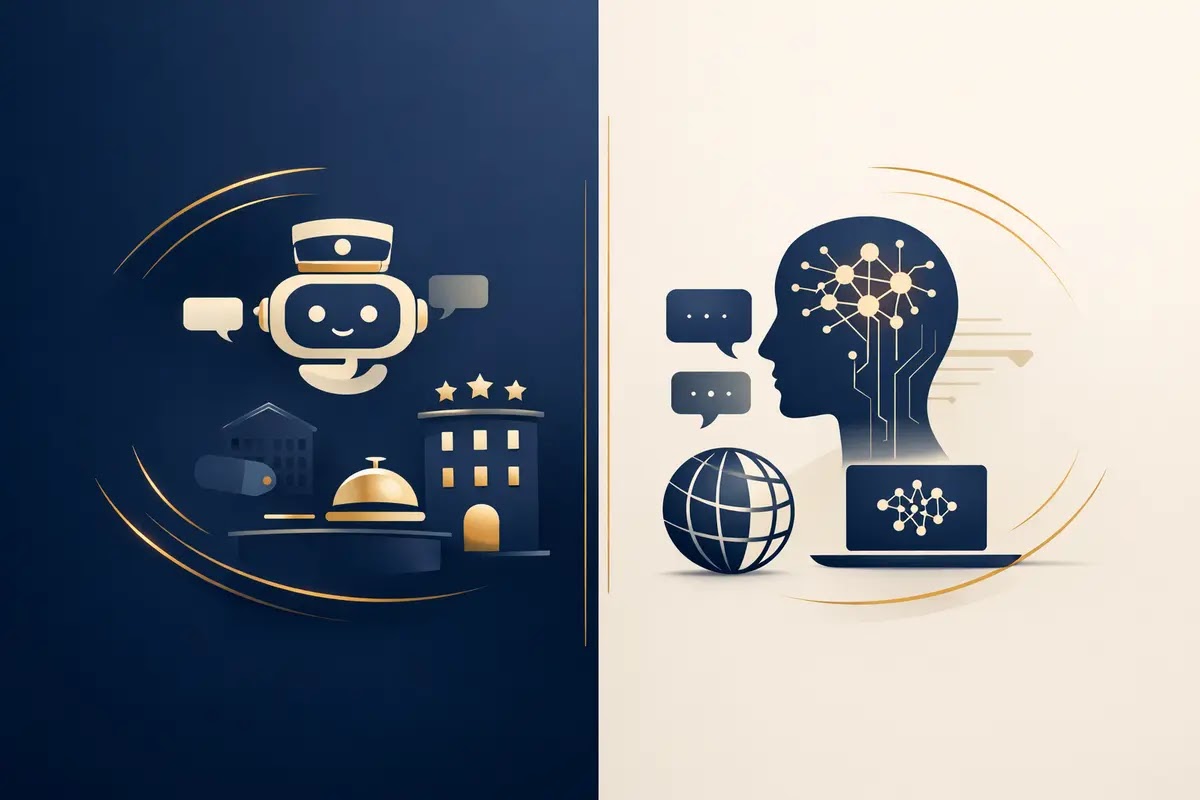
Understanding the Differences Between Hotel Chatbots and AI Conversational Agents
In the hospitality industry, digital innovation is profoundly transforming customer relationships, placing technology at the heart of the experience. Digital managers, CTOs, and IT directors now have multiple tools to optimize interaction with their clients and offer personalized, responsive service. Among these solutions, hotel chatbots and conversational agents powered by artificial intelligence (AI) are often confused, while they actually address different needs and offer varying degrees of sophistication. This article provides a clear comparison between these two technologies to help hospitality professionals choose the best response to their digital challenges.
Hotel Chatbot: Simple and Effective Automation
A hotel chatbot is software programmed to communicate with customers based on pre-established scenarios. Widely used to automate repetitive tasks, it facilitates the handling of simple requests such as service inquiries, booking reservations, or answering frequently asked questions. The chatbot’s major strength lies in its ease of deployment, controlled cost, and ability to provide 24/7 uninterrupted assistance.
However, the chatbot remains limited to basic interactions, often guided by a menu or keyword recognition. It does not truly understand the complex context of requests or the nuances of human conversation. In the hotel setting, this can quickly become frustrating for a customer seeking a more personalized response or specific help. The chatbot’s functional rigidity therefore requires strict management of use cases.
AI Conversational Agent: An Enriched and Dynamic Customer Experience
The AI conversational agent represents the advanced generation of virtual assistants. Equipped with machine learning capabilities and natural language understanding, it interprets customer requests with a finesse that traditional chatbots cannot match. In a high-end hotel, this technology enables a truly smooth dialogue that adapts its responses to specific requests and individual context.
Thanks to artificial intelligence, this agent constantly evolves by learning from past interactions. It anticipates needs, offers personalized recommendations, and solves complex problems, going far beyond simple transactional exchanges. The AI conversational agent can also integrate with the hotel’s internal systems, creating synergy that enriches the customer experience while optimizing operational management.
Nevertheless, this sophistication requires a more significant initial investment, both in development and maintenance. It is also essential to ensure the quality of the data used to train the AI to avoid incorrect or inappropriate responses.
Functional Comparison: What Are the Implications for Hospitality?
In terms of operational and strategic impact, the choice between a hotel chatbot and an AI conversational agent largely depends on the specific goals and needs of the establishment.
The chatbot is suitable for a hotel wishing to automate simple interactions with a quick return on investment, especially to manage a high volume of standard requests. Its implementation does not necessarily require advanced technical expertise and can rely on existing platforms.
Conversely, the AI conversational agent is recommended for establishments that value a differentiated, personalized, and seamless customer experience. Luxury hotels or international hotel groups will find a powerful lever here to enhance their brand image and build loyalty among a demanding clientele. This solution represents a true innovation driver, allowing customer relations to be reimagined as an intelligent and proactive exchange.
The Importance of an Integrated and User-Friendly Solution: The Example of Dooria
Faced with these growing expectations, Dooria stands out as an innovative digital concierge solution optimized for WhatsApp messaging. This platform cleverly combines the advantages of hotel chatbots and AI conversational agents to deliver a seamless and highly personalized user experience.
Dooria supports establishments in establishing instant digital customer relationships capable of addressing travelers’ daily needs while integrating a fine understanding of context. The solution is not limited to a simple bot but acts as a genuine digital assistant, improving customer satisfaction, simplifying request management, and enhancing the versatility of internal teams.
By choosing Dooria, digital managers and IT directors benefit from a powerful, easy-to-deploy tool that harnesses the strength of artificial intelligence applied to hospitality. Integration with WhatsApp, users’ preferred channel, guarantees maximum engagement and direct, instant, and secure communication.
Conclusion: Toward an AI-Enhanced Hotel Customer Relationship
The distinction between hotel chatbots and AI conversational agents is essential to properly guide the digital transformation of hospitality establishments. While the chatbot remains a pragmatic solution for automating basic interactions, only the AI conversational agent offers today the capability to truly enrich the customer experience through contextual understanding and sophisticated personalization.
Performance, brand image, and loyalty challenges require thorough strategic reflection, especially in a competitive sector where the quality of the customer relationship makes the difference. In this context, Dooria offers a comprehensive approach that combines artificial intelligence, user-friendliness, and integration on a universally adopted channel to sustainably modernize hotel customer service.
To discover how Dooria can transform the customer relationship of your establishment, do not hesitate to get in touch or request a personalized demonstration. Harnessing these technological innovations means offering your clients an exceptional experience and preparing the future of your business.